Ordering $4,000 of materials before a customer has paid you a cent is a fast way to run out of cash. That's why most tradies ask for money upfront on bigger jobs — and why it pays to know how to put together a proper deposit invoice in Australia. Get it right and the customer knows exactly what they've paid, what's left, and when the rest is due. Get it wrong and you'll end up arguing about the balance at the end of the job.
This guide covers when to ask for a deposit, what a deposit or progress payment invoice should show, how GST works on part payments, and how to set out the final invoice so the numbers add up.
Deposit vs progress payment — what's the difference?
Both are part payments of the total job price. The difference is timing:
- Deposit: Paid before work starts — usually to cover materials, lock in a start date, and confirm the customer is serious.
- Progress payment: Paid during the job, when you reach an agreed stage (e.g. rough-in complete, frame up, tiling done).
- Final payment: The balance owing once the job is finished, minus everything already paid.
A small job might just be deposit + final. A renovation or new build might have a deposit, three or four progress claims, then a final invoice.
Put the payment schedule on your quote. The deposit amount, each progress stage and when each payment is due should all be agreed before you start. If the customer has accepted a quote that spells it out, every invoice that follows is just doing what was agreed. See quote vs invoice for why the quote matters so much.
How much deposit can a tradie ask for in Australia?
For most trade work there's no fixed rule — it's whatever you and your customer agree. Common approaches are:
- A flat percentage of the job, often somewhere between 10% and 30%.
- The cost of materials you need to order upfront.
- A fixed amount to secure a booking on small jobs.
The big exception is residential building work. Most states and territories have home building laws that cap the deposit you can take on a domestic building contract, and often require a written contract above a certain value. In NSW, for example, the maximum deposit for residential building work is 10% of the contract price. The caps and thresholds differ between states, so check the rules with your state's building regulator before you quote a deposit on home building work.
What to include on a deposit invoice
A deposit invoice is still an invoice, so it needs the same basics as any other. If you're GST-registered and the deposit is $82.50 or more (including GST), it needs to be a valid tax invoice — see our tax invoice checklist for every required field. On top of that, a deposit invoice should make the part-payment clear:
- A clear title — e.g. "Tax Invoice — Deposit" so it isn't mistaken for the full bill.
- The job it relates to — site address and your quote number.
- The total job price — so the customer can see the deposit in context.
- The deposit amount — as a dollar figure and, if relevant, the percentage (e.g. "20% deposit").
- GST on the deposit — shown separately if you're registered.
- A due date — usually "before work starts" or a specific date.
- How to pay — BSB and account number or a payment link, plus the reference to use.
Here's how a deposit line item might look on a $5,500 (inc. GST) bathroom job:
| Description | Amount |
|---|---|
| 20% deposit — bathroom renovation, 12 Smith St (Quote Q-0118, total $5,000 + GST) | $1,000.00 |
| GST (10%) | $100.00 |
| Total due now | $1,100.00 |
How GST works on a deposit invoice in Australia
If you're registered for GST, a deposit that's a part payment towards the job price generally includes GST, just like the rest of the job. Charge 10% on the deposit amount and show it on the invoice. (Not sure of the maths? See how to calculate GST on an invoice.)
When you report that GST depends on your accounting method:
- Cash basis (common for sole traders): you report GST in the BAS period you actually receive the deposit.
- Non-cash (accruals) basis: you report GST in the period you issue the invoice or receive any payment — whichever happens first.
A security deposit is treated differently. If the money is genuinely held as security — for example, refundable once equipment is returned undamaged — the ATO generally doesn't treat it as payment for the job until it's applied to the price or kept. Most tradie deposits are part payments, not security deposits, but if you're unsure which yours is, check with your accountant or BAS agent.
Not registered for GST? Then don't add GST to your deposit — or any other invoice. Just show the deposit amount and note "No GST has been charged". Our guide to the GST registration threshold explains when you need to register.

How to invoice progress payments
For staged jobs, raise a separate invoice each time you hit a milestone. Each progress invoice should:
- Describe the stage completed — e.g. "Progress claim 2: framing complete".
- Show the amount for that stage, plus GST if you're registered.
- Reference the original quote or contract number.
- Optionally show a running summary: total contract, paid to date, this claim, balance remaining.
That running summary takes a few extra seconds but saves a lot of back-and-forth — the customer can see at a glance where the job stands financially.
If you're doing construction work under a contract, your state's security of payment legislation may also give you a formal process for making progress claims and getting paid on time. Those claims usually need specific wording, so check your state's rules if you plan to rely on them. Our guide on how to invoice as a builder goes into more detail.
The final invoice: showing the balance owing
The final invoice is where deposit mistakes usually come to light. The cleanest way to set it out is to show the full job, then subtract what's already been paid:
| Bathroom renovation — total job price (inc. GST) | $5,500.00 |
| Less: deposit paid (Invoice INV-0201, 2 Oct) | −$1,100.00 |
| Balance due (inc. $400.00 GST) | $4,400.00 |
Notice the GST on the final invoice is only the GST on the balance ($400), not the whole job ($500). The $100 of GST on the deposit was already reported when you invoiced or received the deposit. Charging or reporting GST on the full amount again is one of the most common deposit mistakes — and it means you'd pay the ATO twice.
Any variations or extras agreed during the job go on the final invoice as their own line items, so the customer can see why the balance is different from the original quote.
Common deposit invoice mistakes to avoid
- Taking a deposit with no paperwork — always issue an invoice or receipt for it, even if the customer paid cash.
- Double-counting GST — the final invoice should only carry GST on the remaining balance.
- Not linking the invoices — reference the quote number and earlier invoice numbers on every invoice for the job.
- No agreed refund position — say on the quote what happens to the deposit if the customer cancels after you've ordered materials.
- Going over a legal deposit cap on residential building work in your state.
A free invoice app for tradies makes all of this quicker: it adds the GST, numbers each invoice in order, and shows which deposits and progress claims have been paid and which are still outstanding.
Send a deposit invoice in under a minute
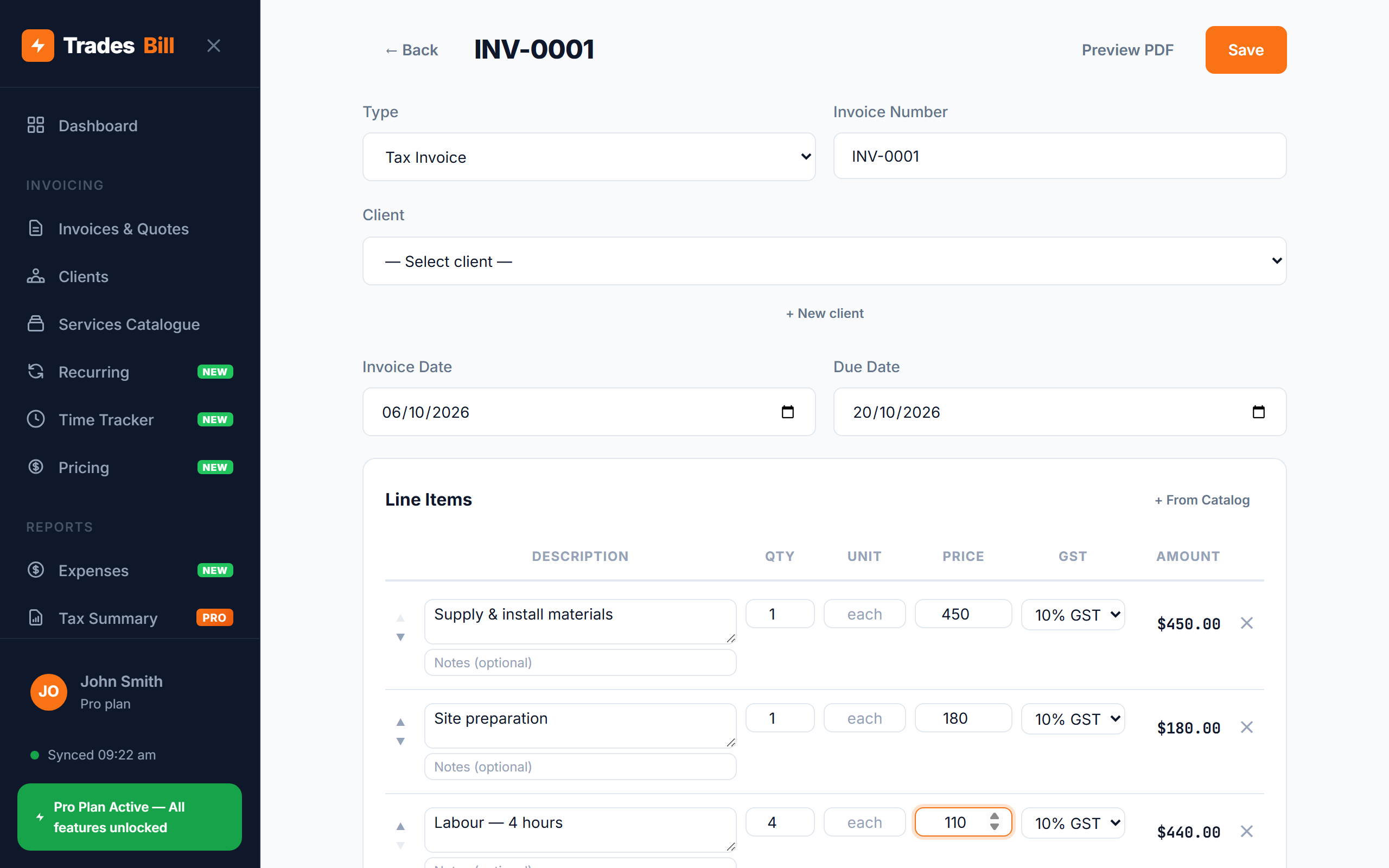
TradesBill works out GST automatically, keeps every invoice for a job numbered and linked, and tracks what's paid and what's still owing. Free forever, works offline.
Create your first invoice — FreeFrequently asked questions
Do I need to charge GST on a deposit?
If you're registered for GST and the deposit is a part payment towards the job, yes — it generally includes GST, and you report it on your BAS. A refundable security deposit is usually treated differently until it's applied to the price or kept.
Should a deposit invoice be a tax invoice?
If you're GST-registered and the deposit is $82.50 or more including GST, issue it as a tax invoice with all the ATO-required details. Your customer may need it to claim GST credits.
Can I keep the deposit if the customer cancels?
It depends on what you agreed. If your quote or contract says the deposit covers materials already ordered or is non-refundable after a certain point, that agreement is your starting point. Australian Consumer Law and state building laws can still apply, so get advice if the amount is significant.
Is a progress payment the same as a progress claim?
In everyday use, yes — a progress claim is the invoice you send to request a progress payment. In construction, "payment claim" can also have a specific legal meaning under your state's security of payment laws.
TradesBill is not a registered tax agent or legal adviser. This article is general information only — get professional advice for your specific situation.