Do I need to add GST to my invoice? It's one of the most common questions new tradies ask, and the answer comes down to one thing: whether you're registered for GST. If you are, you add 10% GST to almost all of your trade work. If you're not, you must not add GST at all. Here's how to tell which applies to you, and how to get the invoice right either way.
Short answer: Registered for GST → add 10% GST to your taxable sales and label the invoice "Tax Invoice". Not registered → don't charge GST, don't show a GST amount, and don't call it a tax invoice. You must register once your GST turnover reaches $75,000 a year.
Do I need to add GST to my invoice if I'm registered?
Yes. Once you're registered for GST, the ATO expects you to charge GST on your taxable sales — and for most tradies, that's nearly everything: labour, materials, call-out fees, travel charges. The GST rate is 10%.
The GST you collect isn't your money. You report it on your BAS and pay it to the ATO, and you claim back the GST you paid on business purchases like materials and fuel.
A small number of sales are GST-free or input-taxed, but they're rare in day-to-day trade work. If you're unsure about a particular item, check with the ATO or a registered tax agent.
Should I add GST to my invoice if I'm not registered?
No. If you're not registered for GST, you can't charge it. That means:
- Don't add 10% on top of your price.
- Don't show a GST line or write "inc. GST" on the invoice.
- Don't title it "Tax Invoice" — just call it an "Invoice".
- Do include your ABN, so the client doesn't have to withhold tax from your payment. See invoicing without an ABN for why that matters.
Charging GST when you're not registered means collecting money you aren't entitled to. If it happens by mistake, fix it with the client straight away.
When do you have to register for GST?
You must register for GST when your GST turnover is $75,000 or more a year — either over the last 12 months or expected over the next 12. You can register voluntarily below that. Once you hit the threshold, you have 21 days to register.
If you should have registered and didn't, the ATO can backdate your registration. You'd then owe GST on sales you've already made — generally one-eleventh of what you charged, even though you never added GST to those invoices. Our guide to the GST registration threshold explains how to work out your turnover.
How to add GST to an invoice correctly
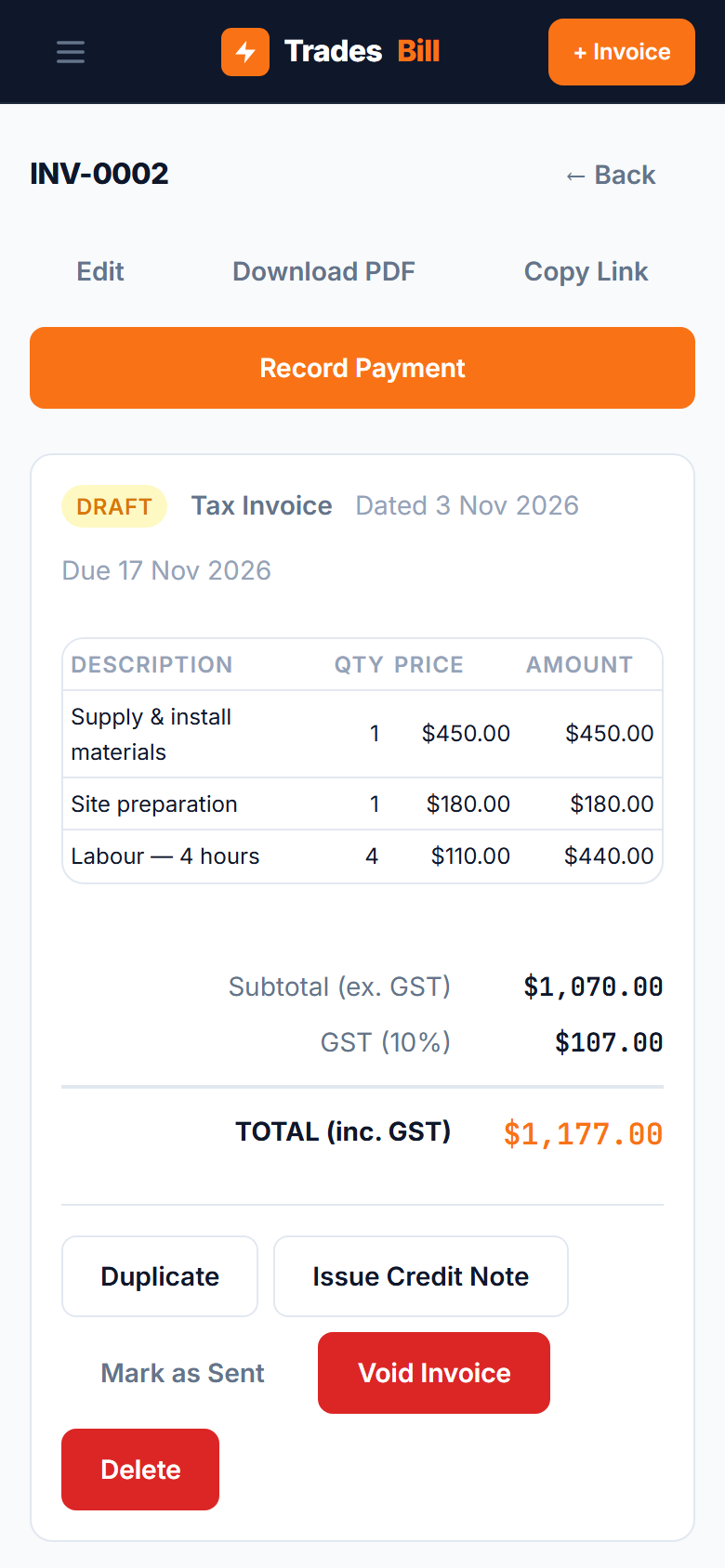
If you're registered, the maths is simple: take your price before GST and add 10%.
| Line | Amount |
|---|---|
| Subtotal (excluding GST) | $1,000.00 |
| GST (10%) | $100.00 |
| Total (including GST) | $1,100.00 |
If your price already includes GST, divide the total by 11 to find the GST component: on a $1,100 total, GST is $100. For more worked examples, read how to calculate GST on an invoice.
A tax invoice should also show your ABN, the words "Tax Invoice", the date, a description of the work, and the GST amount (or a statement that the total includes GST). If a customer asks for a tax invoice for a taxable sale over $82.50 (including GST), you need to provide one within 28 days. Our checklist on what a tax invoice must include covers every field.
What if I quoted without mentioning GST?
This is where tradies get into arguments. If you're registered and your quote said "$1,000" with no mention of GST, the client may reasonably believe $1,000 is the full price. Turning up with a $1,100 invoice can feel like a $100 surprise.
Prices you give to everyday consumers are generally expected to include GST, so the safest habit is to make it unmistakable on every quote:
- Show both figures — "$1,000 + GST ($1,100 total)".
- Or quote GST-inclusive — "$1,100 including GST" — and stick to it.
- Use the same format on your quote and your invoice so the numbers match.
If you've already quoted without GST, have a quick conversation before you invoice rather than adding it on without warning. More tips are in our quote vs invoice guide.
Note: TradesBill is not a registered tax agent. This article is general information only. Confirm your GST obligations with the ATO or a registered tax agent or BAS agent.
How TradesBill handles GST for you
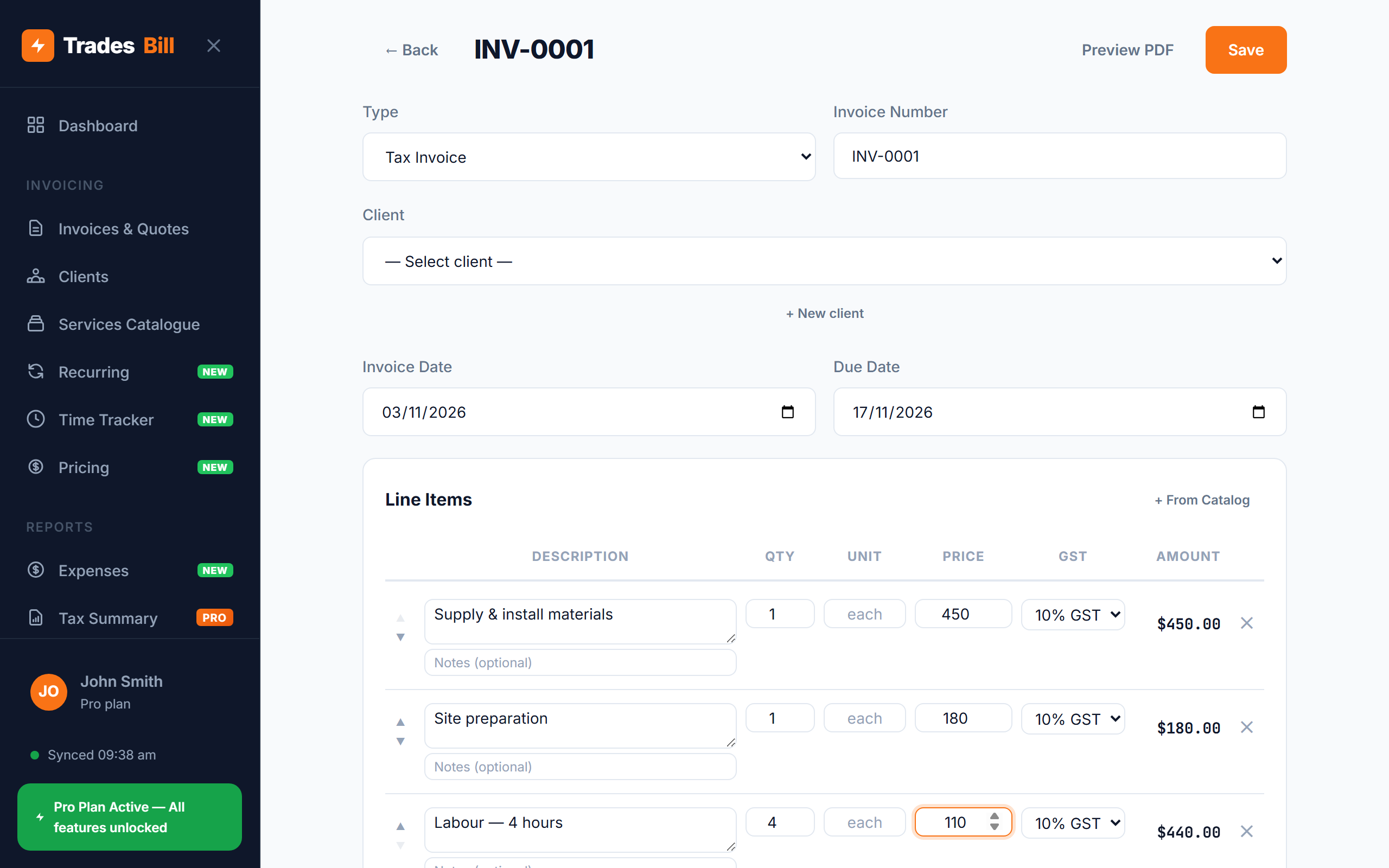
TradesBill is a free invoice app for tradies built around Australian GST. In your business settings you tick whether you're registered for GST:
- Registered: every invoice adds 10% GST per line, shows the GST total separately, and is labelled "Tax Invoice" automatically.
- Not registered: untick the box and TradesBill stops charging GST on new invoices.
- Live totals: the subtotal, GST and total update as you type, so you can check the numbers before you send.
Get GST right on every invoice
TradesBill calculates GST, labels your tax invoices and keeps your ABN on every invoice — free to start, works offline.
Start free — no credit card neededFrequently asked questions
Do sole traders have to charge GST?
Only if they're registered for GST. Being a sole trader doesn't change the rule — you must register (and then charge GST) once your GST turnover reaches $75,000 a year.
Can I add GST to an invoice if I only just registered?
You charge GST on sales made from your date of GST registration. Invoices for sales before that date shouldn't include GST. If you're not sure which date applies, check your registration details with the ATO.
Do I charge GST on materials I pass on to the client?
If you're registered, yes — materials you supply as part of the job are part of your taxable sale, so GST applies to them too. You claim back the GST you paid when you bought them on your BAS.
Is GST always 10%?
Yes, the GST rate in Australia is 10%. Some specific items are GST-free, but for normal trade work you'll charge 10%.